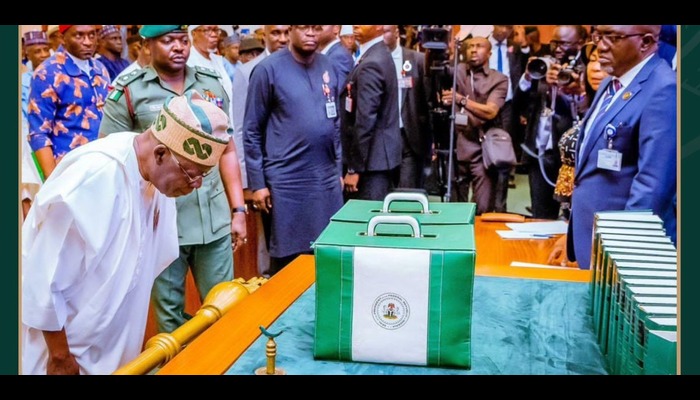
President Bola Tinubu on Wednesday presented a 2025 budget of N47.9 trillion to the National Assembly.
The president explained that in 2025, his administration would direct N4.91 trillion to defence and security; N4.06 trillion to infrastructure, with health sector getting N2.48 trillion, while education would gulp N3.52 trillion.
Accordingly, N34.82 trillion is targeted as revenue, with expenditure projected at N47.90 trillion, including N15.81 trillion for debt servicing.
Describing the fiscal policy as ‘2025 Budget of Restoration, Securing Peace, Building Prosperity,’ Tinubu acknowledged that though the projections were ambitious, they were, however, necessary to secure the country’s future.
This is as he highlighted a total of N13.08 trillion, or 3.89 percent of GDP, as deficit, and a decline in inflation from 34.6 percent in 2024 to 15 percent in 2025.
He underscored an improvement in forex “from approximately N1,700 per US dollar to N1,500, and a base crude oil production assumption of 2.06 million barrels per day (mbpd).”
The president explained that Nigeria’s economy grew by 3.46 percent in the third quarter of 2024, up from 2.54 percent in the third quarter of 2023 with the nation’s foreign reserves standing at nearly $42 billion.
“In 2025, we are targeting N34.82 trillion in revenue to fund the budget. Government expenditure in the same year is projected to be N47.90 trillion, including N15.81 trillion for debt servicing. A total of N13.08 trillion, or 3.89 percent of GDP, will make up the budget deficit.
“Our rising exports are reflected in the current trade surplus, which now stands at N5.8 trillion, according to the National Bureau of Statistics.
“These clear results of gradual recovery, among others, reflect the resilience of our economy and the impact of deliberate policy choices we made from the outset,” the president maintained.
Sectoral allocations in the 2025 budget shows an astronomical improvement from previous years with defence and security attracting N2.98 trillion out of the total budget of N21.83 trillion in 2022.
In the 2023 budget, the military alone gulped N1.55 trillion, showing a breakdown of N917.55 billion for personnel costs, N78.53 billion for overhead and over N297 billion for capital expenditure.
Also, in the 2023 supplementary budget, defence and security got N605 billion out of the total amount of N2,176,791,286,033.
In the last five years, budgetary allocations to the Ministry of Defence have risen by 134.80 percent, from N589.955 billion in 2019 to N2.98 trillion, last year.
Overall, the Federal Government had budgeted $17.17 billion for security and defence from 2018 to date.
Tinubu in his speech stressed that in 2025, the country would reduce the importation of petroleum products, while increasing export of finished petroleum products.
This is as the government foresees increased agricultural production in what the president described as “bumper harvests driven by enhanced security, reducing reliance on food imports.
“Increased foreign exchange inflows through Foreign Portfolio Investments.
“Higher crude oil output and exports, coupled with a substantial reduction in upstream oil and gas production costs.”
He maintained that “the 2025 budget proposal again reinforces our administration’s roadmap to secure peace, prosperity, and hope for a greater future for our beloved nation. This budget christened, ‘Budget of Restoration: Securing Peace, Rebuilding Prosperity,’ strikes at the very core of our Renewed Hope Agenda and demonstrates our commitment to stabilising the economy, improving lives, and repositioning our country for greater performance.
“The journey of economic renewal and institutional development, which we began 18 months ago as a nation is very much underway. It is not a journey of our choosing, but one we had to embark on for Nigeria to have a real chance at greatness. I thank every Nigerian for embarking on this journey of reforms and transformation with us.
“The road of reforms is now clearly upon us, and as the president of this blessed nation, I know this less-travelled road has not been easy. That there have been difficulties and sacrifices. They will not be in vain. And we must keep faith with the process to arrive at our collectively desired destination.
“We must build on the progress we have made in the past eighteen months in restructuring our economy and ensuring it is strong enough to withstand the headwinds of any future shocks of the global downturn.
“The 2025 budget that I present today is one of restoration. It seeks to consolidate the key policies we have instituted to restructure our economy, boost human capital development, increase the volume of trade and investments, bolster oil and gas production, get our manufacturing sector humming again and ultimately increase the competitiveness of our economy.
“We do not intend to depart from this critical path to strengthen the Nigerian economy. Just as I believe in the resilience of our economy to withstand the current challenges, I also strongly believe in the resilience of the Nigerian people. Again, I summon the unstoppable Nigerian spirit to lead us on as we work to rebuild the fabric of our economy and existence.
“The improvements we witnessed in the 2024 budget have led us into the 2025 budget. The goals of advancing national security, creating economic opportunities, investing in our youthful population, infrastructure development, and national re-orientation form the core of the 2025 budget. But more than that, this will lay a solid foundation for Nigeria’s future growth trajectory.”
On the 2024 budget, Tinubu emphasised that the administration achieved a N14.55 trillion revenue, meeting 75 percent target in the third quarter (Q3).
This is followed by a N21.60 trillion in expenditure, representing 85 percent target within the same period.
According to him, the impact of these milestones are gradually being felt in the economy.
He said the economy grew by 3.46 percent in the third quarter of 2024, up from 2.54 percent in the third quarter of 2023.
“Our foreign reserves now stand at nearly 42 billion US dollars, providing a robust buffer against external shocks.
“Our rising exports are reflected in the current trade surplus, which now stands at 5.8 trillion naira, according to the National Bureau of Statistics.
“These clear results of gradual recovery, among others, reflect the resilience of our economy and the impact of deliberate policy choices we made from the outset.”
President Tinubu called for a united effort in repositioning the country, as he assured that the 2025 budget seeks to restore macroeconomic stability, enhance the business environment, foster inclusive growth, employment, and poverty reduction, and to promote equitable income distribution and human capital development.
“Our budgetary allocations reflect the administration’s strategic priorities, especially in the implementation of the Renewed Hope Agenda and its developmental objectives.
“As we embark on implementing the 2025 budget, our steps are deliberate, our decisions resolute, and our priorities are clear. This budget reflects a renewed commitment to strengthening the foundation of a robust economy, while addressing critical sectors essential for the growth and development we envision,” he stressed.
On security, he maintained that the administration considers it the foundation of all progress.
“We have significantly increased funding for the military, paramilitary, and police forces to secure the nation, protect our borders, and consolidate government control over every inch of our national territory.
“The government will continue to provide our security forces with the modern tools and technology they need to keep us safe. Boosting the morale of our men and women in the armed forces will remain our government’s top priority.
“The officers, men, and women of our Armed Forces and the Nigeria Police Force are the shields and protectors of our nation. Our administration will continue to empower them to defeat insurgency, banditry, and all threats to our sovereignty. Our people should never live in fear— whether on their farmlands, highways or cities. By restoring peace, we restore productivity, revive businesses, and rebuild our communities,” he highlighted.
This is even as he explained that with the Renewed Hope Infrastructure Development Fund, the administration has accelerated investments in energy, transport, and public works.
The president added, “By leveraging private capital, we hope to complete key projects that drive growth and create jobs. We have already embarked on key legacy projects: Lagos-Calabar Coastal Highway and Sokoto-Badagry Highway, which will have a huge impact on the lives of our people and accelerate economic output.
“Our people are our greatest resource. That is why we are making record investments in education, healthcare, and social services:
“Our administration has so far disbursed N34 billion to over 300,000 students via the Nigeria Education Loan Fund (NELFUND). In the 2025 budget, we have made provision for N826.90 billion for infrastructure development in the educational sector. This provision also includes those for the Universal Basic Education (UBEC) and the nine new higher educational institutions.
“We are convinced that Universal Health Coverage initiatives will strengthen primary healthcare systems across Nigeria. In this way, we have allocated N402 billion for infrastructure investments in the health sector in the 2025 budget and another N282.65 billion for the Basic Health Care Fund.”
PDPDescribesTinubu’sN47.9trn2025 Budget As Anti-People
Meanwhile, the Peoples Democratic Party (PDP) has described the N47.9 trillion 2025 budget presented by President Bola Tinubu to the National Assembly on Wednesday as anti-people, which if implemented as presented will plunge the nation deeper into the abyss of insecurity, poverty and hopelessness.
The party asserted that the budget as presented further confirms the insensitivity of the Tinubu-led All Progressives Congress (APC) administration towards the plight of Nigerians as it made no meaningful provisions and investments for critical productive sectors of agriculture and food production, electricity, petroleum and gas, Small and Medium Scale Enterprises, which are the real drivers of the national economy.
The PDP, in a statement by its spokesman, Hon. Debo Ologunagba, said that the budget address sounded more like a campaign rhetoric laced with unsubstantiated economic statistics, false promises and conjured performance claims without clear-cut operable steps and mechanisms to address insecurity, resuscitate the economy, revamp ailing industries, shore up food production, increase the value of the naira, reduce overall cost of living, create jobs for our youths and guarantee better living standard for citizens.
“President Tinubu dashed the hope of millions of suffering Nigerians, who expected him to use the 2025 budget to make strategic provisions that will lead to the reduction in the cost of fuel, food items, electricity tariff and other essential goods and services that have direct bearing on the wellbeing of the people.
“The PDP is dismayed that instead, the budget speech was an assault on the sensibility of Nigerians when Mr. President claimed that the 2024 budget recorded a bogus 85% performance without a breakdown of the component between recurrent and capital expenditure.
“Further distressing is President Tinubu’s claim that the economy improved under his watch even in the face of acute poverty, excruciating hardship, comatose infrastructure, collapsed productive sectors, deteriorating value of the naira, alarming 34.6% inflation and 40% unemployment rates in the last 18 months as validated by official figures.
“Equally ludicrous is Mr. President’s voodoo economy claim that the 2025 budget will reduce the current inflation rate from 34.6% to 15% and improve the value of the naira from approximately N1,700 to the dollar to N1,500 without any indices for tangible investment in the productive sector and in the face of a staggering N134.3 trillion ($91.3 billion) debt accumulated under the APC watch.”
SOURCE: INDEPENDENT