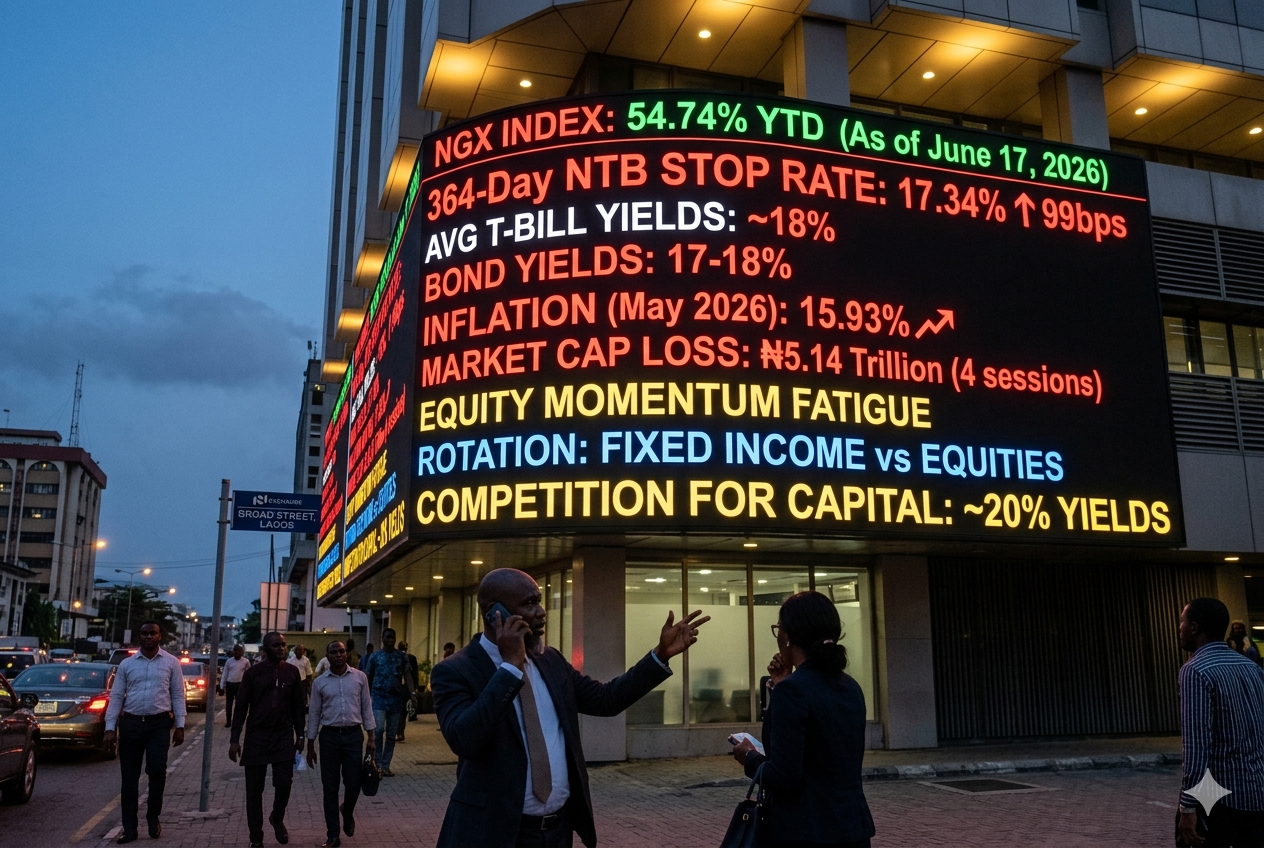
The Nigerian stock market has enjoyed a remarkable run, at 54.74% YTD as at yesterday, June 17. But lately, a new question is beginning to dominate investment conversations: Why take equity risk now? The answer may explain why the broad-based rally in equities is starting to lose momentum.
At yesterday, June 17 NTB auction, stop rates rose sharply, with the 364-day bill climbing 99 basis points to 17.34%. This marks a clear trend: rates have increased across all tenors in recent auctions. In secondary market, over the past couple of weeks, fixed-income yields have resumed their upward march. Average Treasury Bill yields are approaching 18%, while bonds in the middle of the curve are hovering around 17-18%. At the same time, institutional investors have been selling fixed-income securities in anticipation of reinvestment opportunities at potentially higher rates. The market’s expectations are not without basis.
This rotation is occurring against a backdrop of renewed inflationary pressure. Inflation has recorded three consecutive monthly increases since March, reaching 15.93% in May. Government borrowing requirements remain elevated, with a projected ₦29.2 trillion for 2026, representing ₦11.31 trillion increase from earlier estimates. This persistent supply pressure, as evidenced by the ₦1.86 trillion in subscriptions against a ₦1 trillion offer at the June 17th auction, suggests that stop rates may remain elevated, potentially reaching near 18%, as market expectations align with this fiscal reality. At the June 3rd auction, ₦1.24 trillion was allotted for the 364-day bill against the ₦800 billion on offer for it. The pattern was similar at the June 17th auction too: ₦1.29 trillion was allotted for the same bill against the same amount offered. More supply typically translates into pressure for higher stop rates, particularly if demand does not keep pace.
For portfolio managers, the mathematics is becoming increasingly compelling, even despite the massive over ₦4 trillion system liquidity enough to chase multiple asset classes. If a relatively risk-free instrument can deliver close to 20% or more, the hurdle rate for equities rises significantly. Suddenly, an expected 20-25% return from stocks may no longer look attractive when weighed against higher volatility, earnings uncertainty, and growing pre-election risks (GTI Research has a study on this here). No wonder the equity market’s momentum is already showing signs of fatigue: after a historic 61.38% YTD peak in May, the market recently experienced a sharp correction, shedding ₦5.14 trillion in four sessions, from ₦160.50 trillion on June 1, the first day of the T+1 settlement cycle transition, to ₦155.36 trillion on Thursday, June 4.
This does not necessarily signal the end of opportunities in the equity market. Rather, it suggests a transition from the broad-based rally we saw from the beginning of the year to a selective market going forward where earnings quality, valuation discipline, and defensive positioning matter more than momentum. In this new regime, the evidence points to sectors offering resilient value: fundamentally sound Banking stocks trading below book value with high dividend yields, defensive Consumer Goods/Industrial names with proven pricing power, and select Oil & Gas counters where recent profit-taking has created attractive entry points in a sector still supported by robust underlying fundamentals.
As Nigeria gradually moves toward the 2027 election cycle, investors will likely become more sensitive to risk-adjusted returns. In that environment, fixed income may continue to attract capital, especially if auction stop rates remain elevated.
For now, the market is sending a clear message: the competition for investor capital is no longer between stocks and cash – it is between stocks and nearly 20% government-backed yields.
And that changes everything.