
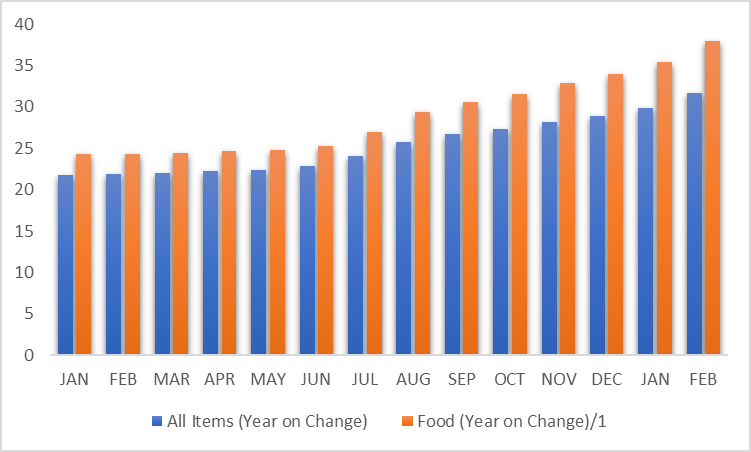
In February 2024, the headline inflation rate increased to 31.70 per cent relative to the January 2024 headline inflation rate which was 29.90 per cent. According to the Consumer Price Index and Inflation report from the National Bureau of Statistic (NBS), the hike represented a 1.80 per cent increase from 29.9 per cent recorded in January, 2024 per cent.
On a year-on-year basis, Nigeria’s headline inflation rate was 9.79 per cent higher, compared to 21.91 per cent recorded in February 2023 while food inflation stood at 13.57 per cent higher. Increases in prices of food items like bread, yam, potatoes, cereals, fish, oil and fat, cocoa, meat, fruit, coffee, and tea were triggered by the state of insecurity, the removal of fuel subsidies on petroleum, and the floating of the naira.
Food inflation however was at 37.92% in contrast with 35.41% recorded in the previous month, January 2024. on a month-on-month (M-O-M) basis, the headline inflation rate in February 2024 was 3.12%, which was 0.48% higher than the rate recorded in January 2024 (2.64%).
Core inflation, which omits the costs of volatile agricultural products and energy, was 25.13% in February 2024, showing a 6.76% increase from the 18.37% recorded in February 2023. Month-on-month, the core inflation rate decreased slightly to 2.17% in February 2024 from 2.24% in January 2024, a drop of 0.07%.
In February 2024, the urban inflation rate on a year-on-year basis reached 33.66%, an increase of 10.87 percentage points from the 22.78% observed in February 2023. Month-on-month, the urban inflation rate in February 2024 was 3.17%, which is 0.45 percentage points higher than the 2.72% recorded in January 2024.